Money Heist & Valeria Filming Locations in Madrid: Full Guide
Explore real Madrid filming locations from Money Heist and Valeria. Walk-friendly routes, costs, and insider tips for screen tourism done right.
A friend called me a few months ago to tell me he'd booked a flight to Madrid "because of a TV show." I asked which one. "Valeria," he said, sounding slightly embarrassed, as if admitting that a Netflix series had convinced him to buy a plane ticket was something that needed defending. I told him to relax. I'd done the exact same thing. More than once.
Tracking down real filming locations from your favorite shows is a completely legitimate, surprisingly specific, and genuinely fun way to explore a new city. If you're planning to follow the Money Heist and Valeria routes through Madrid, the short answer is: yes, it's absolutely worth it, most of the spots are walkable or a short metro ride apart, and you can cover a solid full day without spending more than $20-25 on transport and food if you plan it right. The longer answer is everything below.
Quick things to know before you start:
- Money Heist locations are concentrated in the historic center and the La Latina neighborhood
- Valeria covers hipper, more residential areas like Malasaña, Lavapiés, and Retiro Park
- You can do a combined route comfortably over two days, or squeeze it into one long day if you have to
- Weekday mornings are your best bet for photos with fewer crowds
- You don't need a guided tour. Google Maps and this article will get you where you need to go
What Makes Madrid Such a Perfect Filming City?
Madrid has been a backdrop for film and TV for decades, but it was Money Heist that completely changed the game. The show turned streets, plazas, and government buildings into globally recognized icons, and suddenly tourists from South Korea, Brazil, and Germany were showing up in the city center asking for directions to "the bank" with the same intensity you'd expect from someone searching for the Eiffel Tower.
Valeria operates differently. It has a quieter international profile than Money Heist, but it's deeply beloved across Spain and Latin America, and it does something that bigger productions rarely bother with: it shows the everyday version of Madrid. Neighborhood terraces, small bookshops, Sunday afternoons in the park. The Madrid that most visitors on a three-day trip never actually see because they're too busy moving between landmarks to slow down and look around.
This connects to something I've been thinking about a lot lately around screen tourism and how a fictional story can honestly be a better introduction to a city than any traditional travel guide. When you're looking for something specific and personal, you pay a different kind of attention. You notice the light on the buildings. You linger in a square because you recognize it, and while you're standing there you actually absorb the place instead of just photographing it and moving on.
Honestly, half the time I'm not even sure if what I'm doing counts as "screen tourism" or just finding an excuse to sit at a very specific sidewalk cafe because it appeared in a scene I liked. Either way, it works.
The Real Money Heist Filming Locations in Madrid
Here's the thing that confuses almost every first-time fan who shows up looking for "the bank": the heist building you see on screen is not actually the Bank of Spain. What the show uses is a combination of the Prado Museum shot from specific angles, plus the real Bank of Spain building near Plaza de Cibeles for certain exterior scenes. The two buildings are distinct, but the editing makes them read as one. Once you know this, the whole thing clicks into place.
Places you can actually visit and recognize from the show:
-
Plaza Mayor: Several scenes involving the police operation and the chaotic street-level tension were filmed here or in the immediate surrounding area. It's Madrid's most visited public square, always free to enter, and crowded at basically any hour. Good for photos, but you'll have company.
-
Mercado de San Miguel: Referenced and used in scenes adjacent to the market during the first season. Worth stopping in regardless, if only for a glass of wine or some jamón. A glass of house wine runs roughly $2.75 to $4.50 depending on the stall.
-
La Latina and Lavapiés neighborhoods: Multiple exterior chase sequences and urban scenes were shot throughout these areas. There's no single address to hunt down, but walking south from Plaza Mayor along Calle de Toledo and ducking into the side streets gives you a strong visual match to what you see on screen.
-
Atocha Station and surrounding streets: The area shows up repeatedly as urban backdrop throughout the series. Practical bonus: if you're arriving in Madrid by high-speed train, you'll land here anyway.
One thing almost no guide mentions: the building that most closely resembles the visual aesthetic of the show's fictional bank is the Ministry of Agriculture on Paseo de la Infanta Isabel. It's not famous. It's not on any "must-see" list. But it's architecturally stunning in a heavy, ornate way that photographs incredibly well, and there are almost never tourists there.
Valeria's Madrid: The Neighborhoods the Show Turned Into Destinations
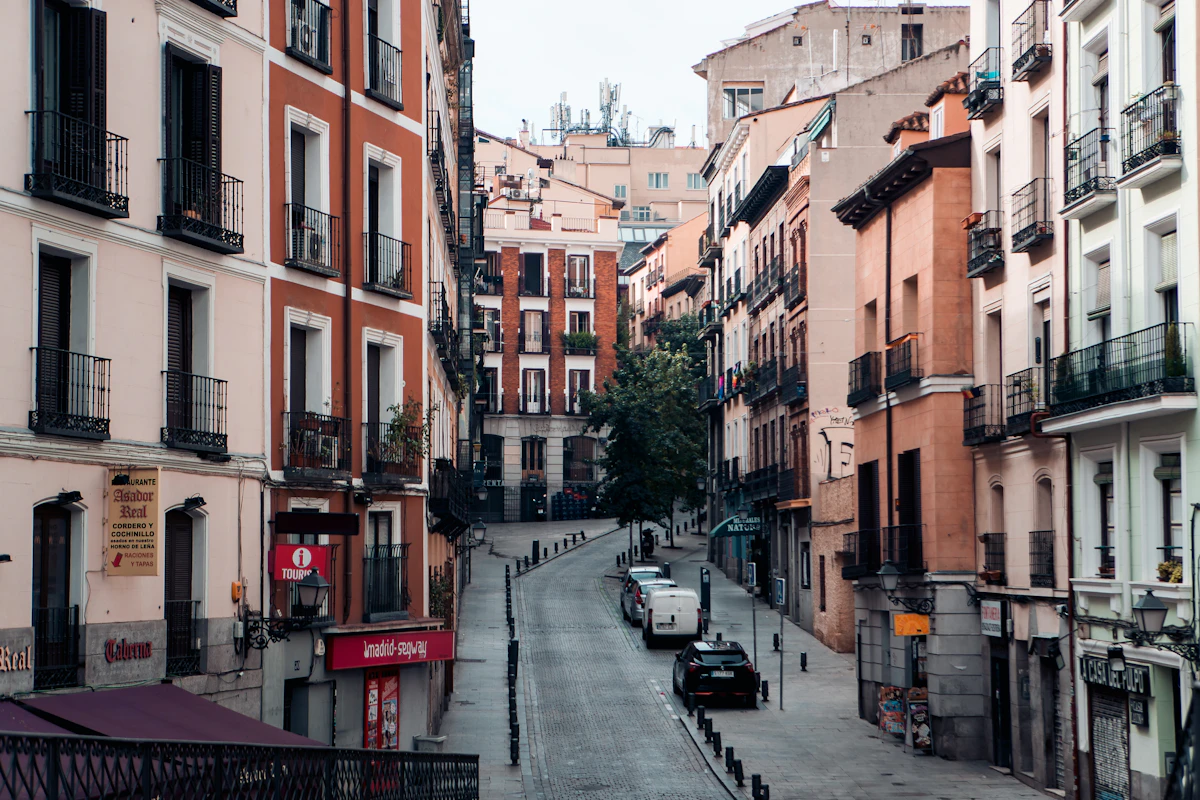
Valeria is more generous with specific, identifiable locations because the neighborhood itself functions as almost a character. Malasaña appears constantly throughout the series, and if you watched with any attention, you'll recognize the vibe immediately when you turn the corner.
Fuencarral Street and the blocks branching off it serve as a near-permanent backdrop for the show. The secondhand bookshops near Tribunal metro, the bars with chairs spilling onto the sidewalk, the vintage clothing stores. All of it is real and accessible. When you see Valeria walking down a street looking like she's working through a major life crisis, that street is almost definitely somewhere in this stretch.
Retiro Park shows up in multiple conversation and walking scenes. If you go on a Sunday morning, you'll see exactly what the show captures: joggers, families, street musicians, and the specific quality of Madrid morning light that exists roughly between 9 and 11 a.m. before the heat arrives. (Practical note: the park is free. Rowboat rentals on the lake run about $9 per hour for a two-person boat.)
Lavapiés gets more screen time in the second season. It's the most genuinely multicultural neighborhood in Madrid and also the one that has changed the most over the past decade, with new restaurants, art spaces, and a creative energy that didn't exist there ten years ago. My honest recommendation here is to show up without a specific agenda and just walk. There's a bookshop on Calle de Argumosa that appears briefly in a shot and is worth visiting even if you've never seen the show, because it stocks zines and small-press editions you won't find anywhere else in the city.
Valeria works better as an emotional map than as a list of coordinates. You won't find plaques or markers. What you'll find is the atmosphere.
How Much Does This Route Actually Cost in 2026?
Let's get into the real numbers.
Getting around: A single metro ticket in Madrid costs approximately $1.65 USD (the official price is 1.50 EUR, conversion fluctuates). If you're planning to move around a lot over two days, the 2-day tourist travel card runs around 14.20 EUR according to the Madrid Metro website and covers metro, commuter rail, and bus. For the central neighborhoods where most of these locations sit, walking is often faster than waiting for the metro anyway.
Food: If you eat at neighborhood markets or at bars that don't cater specifically to tourists, a full set lunch (menú del día, which includes a first course, main, bread, and a drink) runs between $12 and $16. In Malasaña, you can still find spots under $13 if you look for bars without English-language Google reviews. The ones with English reviews have generally adjusted their prices accordingly.
Guided tours: Dedicated Money Heist tours of Madrid do exist. I've seen them listed on platforms like Viator and Civitatis for roughly $16 to $27 per person. I haven't personally done one because I prefer setting my own pace, but if you're someone who genuinely enjoys having a local guide add context and backstory, it can be worth it. If you'd rather save the money, this article and Google Maps Street View will handle the navigation just fine.
Here's a quick cost breakdown for a two-day route:
| Expense | Estimated Cost (USD) |
|---|---|
| 2-day metro pass | ~$15.50 |
| Two set lunches (menú del día) | ~$26-32 |
| Coffee and snacks | ~$10-15 |
| Retiro rowboat rental (optional) | ~$9 |
| Mercado de San Miguel drinks | ~$8-12 |
| Total estimate | ~$68-83 |
That's for a fairly comfortable two days of exploring, not counting accommodation or flights.
The Madrid That Neither Show Ever Films
Here's the honest take I want to sneak in: the neighborhoods that will give you the deepest sense of what Madrid actually is don't appear in either of these series. Carabanchel, Vallecas, the southern and working-class parts of the city that Netflix lighting crews have never touched. That doesn't mean you should skip the center and head straight there, but if you spend three or more days in Madrid and you've only walked the Malasaña-Retiro-La Latina triangle, you've seen the highlight reel, not the city.
I say this knowing full well that every time I go back to Madrid I tell myself I'm finally going to explore the southern barrios more seriously, and I always end up back at a table in Plaza de Santa Ana because it's genuinely irresistible and I have no self-control about this particular thing.
If you have extra days and want to see a side of Madrid that no streaming platform has packaged for you yet, neighborhood festivals are massively underused by international visitors. Many are completely free, they run throughout the summer, and they show you a version of the city that feels genuinely lived-in rather than curated for cameras.
Can You Do the Whole Route in One Day?
Technically, yes. Two days is the ideal pace, but if you're working with a single full day, here's a sequence that actually flows:
- Early morning (8:30 to 11:00 a.m.): Malasaña and Fuencarral before everything opens. Coffee, walking, Valeria energy
- Mid-morning into afternoon (11:00 a.m. to 1:30 p.m.): La Latina, Plaza Mayor, Mercado de San Miguel. This is your Money Heist window
- Late afternoon (4:00 to 7:00 p.m.): Lavapiés into Retiro Park. Covers both shows and ends with a sunset in the park
The problem with cramming it into one day is that you end up rushing, and rushing through Madrid is almost a philosophical contradiction. The city rewards people who linger. The best things that happen to you there, the conversation you didn't expect, the bar you found by accident, the light hitting a building at just the right moment, all of those require you to slow down enough to notice them.
Where to Eat Near the Filming Locations Without Getting Ripped Off
Madrid has a real tourist-trap restaurant problem in the immediate vicinity of major landmarks. The blocks directly around Plaza Mayor are priced for visitors and the quality rarely matches what you pay. Walk two blocks in any direction and the math changes completely.
In the Valeria zone around Malasaña and Tribunal, the neighboring area of Chamberí (about ten minutes on foot) has a strong concentration of solid, unfussy restaurants serving genuinely good food at prices that haven't been adjusted for tourist season. That's where I'd aim for dinner after a full day of walking.
For finding places that aren't on the tourist radar, Google Maps with the reviews filtered to show only Spanish-language comments is more useful than it sounds. If a restaurant has 400 reviews and only 12 of them are in English, that's a good sign.
One practical note for a long day of walking between neighborhoods: Madrid is noisier and more sensory-intense than a lot of American cities, especially on weekends when the streets around Malasaña and La Latina get genuinely loud. If you're sensitive to that kind of overstimulation, earplugs for the metro and packed bars will feel like a genuine quality-of-life upgrade by the end of hour eight.
Practical Stuff Before You Go
Flights to Madrid from major US cities typically run between $500 and $900 round trip depending on the season and how flexible you are with dates. Airlines like Iberia and Air Europa are worth checking, as are routing options through Lisbon or Amsterdam, which can sometimes bring the price down. Spring shoulder season (April and May) tends to hit a sweet spot of reasonable prices and genuinely pleasant walking weather.
Once you land, Madrid's Barajas Airport is well connected to the city center via metro Line 8. The ride takes 35 to 40 minutes and costs around $5.50 USD including the airport supplement.
Weather matters a lot for this kind of walking-heavy trip. July and August in Madrid are serious. Temperatures regularly push past 95°F, which makes an eight-hour walking route considerably less enjoyable. The best months for this kind of screen tourism itinerary are April through June or September through October. You get good light, manageable temperatures, and fewer tourists competing for the same photo angles.
Spain uses European-style plugs (Type C and F). If you're coming from the US, bring a universal adapter.
I'll close with something that's more of an observation than a recommendation: visitors who come to Madrid chasing something specific from a show they love tend to enjoy the city more than people who show up with a generic list of monuments to check off. I think it's because the search makes you pay closer attention. You're looking for something that feels personal, so you look harder, linger longer, and end up absorbing more of the place than you expected.
Or maybe it's just that TV shows teach you to read a city as something full of people and stories rather than a collection of old buildings. Either way, it works. And if you figure out the deeper reason while you're sitting at a terrace in Malasaña with a glass of something cold, I'd genuinely love to hear your theory.
Compartir artículo