24 Hours in Cuéllar: Medieval Castles, Lamb & Hidden Gems
Discover Cuéllar, Spain's most underrated medieval town. Stunning Mudejar churches, a jaw-dropping castle, and the best roast lamb you'll ever eat.
A friend of mine said something over coffee once that really stuck with me: "We always chase the far-away places and completely ignore what's right in our backyard." He was talking about Spain, but honestly? That hits just as hard for Americans too. I've been traveling seriously for over a decade, and there are corners of the Iberian Peninsula I discovered way later than places in Southeast Asia that took three flights to reach. Cuéllar was one of them.
Cuéllar is a small medieval town in the northern part of the Segovia province in Castile, about 90 miles north of Madrid. You can absolutely do it in 24 hours. It has one of the best-preserved collections of Mudejar architecture in all of Castile, a castle that will genuinely stop you in your tracks, and a food tradition built around wood-fired roast lamb that, by itself, is worth the drive.
Here's the short version of what you're getting into:
- A 15th-century castle-palace with sweeping views over the Cega River valley
- Mudejar churches declared national Cultural Heritage sites
- A partially intact medieval wall wrapping around the old town
- Wood-fired roast lamb at restaurants with decades of history
- Prices that feel like a time warp compared to the rest of tourist Spain
How to Get to Cuéllar from Madrid
Let's get the honest part out of the way first, because most travel blogs skip it: getting to Cuéllar by public transportation is doable, but it requires patience and some planning.
The most direct public transit option is a bus from Madrid's Estación Sur (the main south bus terminal near Méndez Álvaro metro) with a regional carrier. The route goes through Segovia city, and from there you can connect to Cuéllar. Total travel time runs around two and a half hours, and the schedules are limited on weekdays, even more so on weekends.
Driving changes everything. From central Madrid, it's roughly 87 miles via the A-1 highway heading toward Burgos, then a cutoff toward Cuéllar. You're looking at about an hour and fifteen to an hour and twenty minutes depending on traffic. A weekend car rental from Madrid typically runs $40 to $60 USD through comparison sites like Rentalcars or Kayak, though prices shift constantly.
My honest recommendation: if renting a car isn't something you want to deal with, combine Cuéllar with a night in Segovia city, which has easy high-speed train access from Madrid (around 30 minutes on the AVE). From Segovia, local buses to Cuéllar take about 45 minutes. That combo actually makes for a really solid two-day trip.
The Castle: Way More Impressive Than You're Expecting
I'll be straight with you. When I pulled up photos of Cuéllar's castle before visiting, I thought "okay, another Castilian castle." I'd seen plenty. I was wrong to be dismissive, and I knew it the second I saw it in person.
The Castillo de Cuéllar is this fascinating hybrid of medieval fortress and Renaissance palace. It belonged to the Duke of Alburquerque, and the bulk of what you see today dates to the 15th century, with some sections going back to the 13th. What makes it genuinely surprising isn't just the scale (which is considerable) but its condition and its current life. This castle functions as a local high school today. Real teenagers walk through those medieval gates every morning to go to class. I found that completely surreal in the best possible way.
Guided tours run between $3 and $5 USD depending on the ticket type. Hours shift with the season, so check the Cuéllar town hall website before you show up. Weekends typically have more tour slots available. Even if you can't get inside, the exterior views over the Castilian countryside and the Cega River valley are worth stopping for on their own.
The Mudejar Architecture Nobody Talks About (But Should)
Cuéllar has ten Romanesque-Mudejar churches. Ten. And most of them see a fraction of the visitors they deserve.
For context: Mudejar architecture is this remarkable medieval Spanish style that blends Islamic construction techniques, mainly elaborate brickwork, with Christian Romanesque forms. It developed as Muslim craftsmen continued working in Christian-controlled territories after the Reconquista. The results are stunning and deeply specific to this part of Spain.
The ones you shouldn't skip:
- San Esteban: One of the best-preserved of the bunch. The Mudejar apse is basically a textbook example of medieval Castilian brickwork.
- San Martín: More austere overall, but the tower has details that reward a few minutes of real attention rather than a quick glance.
- San Andrés: Part of a former convent. Access can be irregular, but it's worth checking.
- Santa Clara: An active convent, so it's not always open to visitors, but the exterior alone has real character.
The entire collection is designated as a national Cultural Heritage site. What strikes me about Cuéllar compared to other heritage towns I've visited is that nobody here is performing their history for tourists. People live here. They pick up bread at the corner bakery and walk past a 12th-century apse without giving it a second thought. There's something about that normalcy that feels more valuable to me than any perfectly curated heritage experience.
The Roast Lamb Is the Real Reason to Make the Drive
I'm not going to pretend the Mudejar churches were what initially pulled me toward Cuéllar. It was the lamb. And I have zero regrets about admitting that.
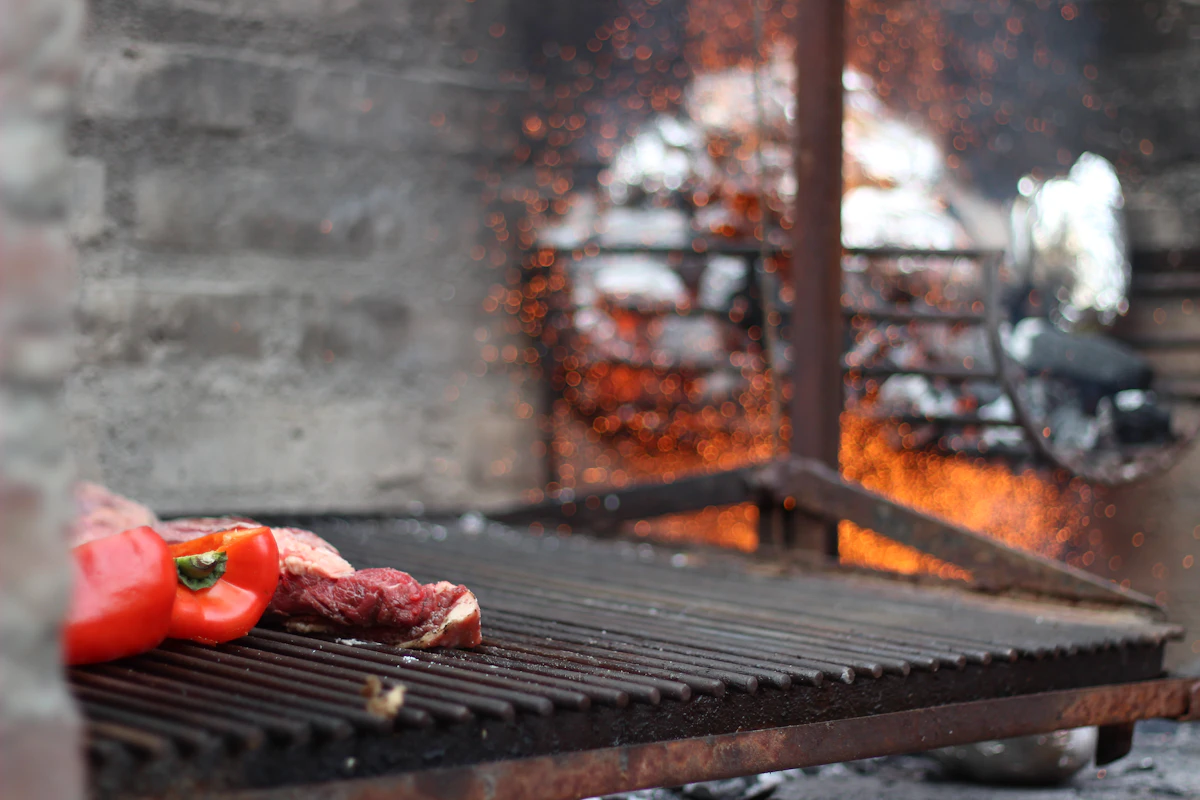
The local specialty is lechazo churro, a traditional Castilian milk-fed lamb breed. The lambs are roasted in wood-fired clay ovens for hours, with nothing but water and salt. What comes out is meat that falls off the bone with crispy skin that has absolutely no business being as good as it is. If there were a UNESCO list for cooking techniques, this would be on it.
Several restaurants in Cuéllar have been doing this for decades. Asador El Jardín and Mesón El Zagal are names you'll hear consistently from locals, though menus and prices shift by season. A quarter lamb per person (which is the standard serving and is a proper amount of food) runs roughly $20 to $26 USD depending on where you eat. For what you actually get, that's genuinely honest pricing.
Here's my slightly unpopular opinion: the roast lamb in Cuéllar is every bit as good as what you'll find in Aranda de Duero or Peñafiel, two towns that get significantly more press for this dish. Cuéllar is at the same level, with none of the tourist crowds. If you're road-tripping through Castile and building any kind of food-focused itinerary, this needs to be a stop.
Should You Stay Overnight?
This is a question I genuinely wrestle with for a lot of Spanish inland towns, and Cuéllar is no exception.
Here's my honest take: it depends entirely on what you're after. If you're driving up from Madrid on a Saturday, you can arrive mid-morning, visit the castle, walk the old town, eat an incredible lunch, and be back in Madrid by early evening. The day trip version works well and doesn't feel rushed if you're reasonably efficient.
That said, staying overnight gives you something the day-trippers never get. After the lunch crowd clears out, Cuéllar's old town takes on this quiet, slightly ghostly atmosphere (in a genuinely beautiful way) that's hard to describe and impossible to experience if you're back on the A-1 by 5pm. The stone streets empty out, the light gets warm and low, and the churches cast long shadows across the cobblestones. It's really something.
Accommodation options are limited, which should calibrate your expectations. There are small rural guesthouses in and around town, some traditional inns, but don't expect a boutique hotel with a rooftop bar. Budget around $65 to $95 USD per night for a double room in a rural guesthouse, with some variation depending on the season.
One thing no travel article ever seems to mention about staying in small historic towns: the next morning's breakfast at a local bar, with fresh bread and a coffee that isn't trying to be anything fancy, is often the best single moment of the entire trip. You don't get that if you drove home the night before.
The Medieval Wall and the Walk That Takes Longer Than You'd Think
Cuéllar still has substantial sections of its medieval wall, though not a continuous circuit. What remains is enough to trace the original perimeter of the town and piece together how significant this fortification once was.
A relaxed walk along the exterior of the wall takes about an hour if you keep moving. The problem (the good kind of problem) is that you won't keep moving. Every hundred meters there's another Mudejar apse poking up above a roofline, another detail in the brickwork, another angle that makes you stop and actually look. I went on an October morning when almost nobody else was around and turned a one-hour walk into three hours without noticing.
The old town sits on a slight elevation, which gives you real views over the surrounding Castilian countryside. Wear comfortable walking shoes. The cobblestones and uneven pavement will make you regret anything with a hard sole.
Cuéllar in August: The Oldest Bullfights in Spain
If your trip lands in August, you'll encounter something that most travel guides either gloss over or skip entirely: Cuéllar hosts a traditional bullfighting festival with documented records going back to 1215. That makes it the oldest such festival in Spain by written record, predating Pamplona's San Fermín by several centuries.
This is the kind of detail that generates strong reactions, and I understand why. It's not the type of attraction that appeals to everyone, and that's completely fair. But from a purely historical standpoint, the fact that this town has been running this same festival since the 13th century is extraordinary, and any honest article about Cuéllar should mention it with appropriate context.
Practically speaking: if you visit in August, the town transforms completely. Accommodation prices go up, crowds arrive, and the atmosphere is entirely different from the peaceful heritage-town vibe that defines the rest of the year. For the quiet Mudejar experience, aim for September, October, or May. Those shoulder-season visits are when Cuéllar really shows its best side.
Real Budget Breakdown: What a Day in Cuéllar Actually Costs
Here's an honest look at the numbers for a full day without overnight accommodation:
| Expense | Estimated Cost (USD) |
|---|---|
| Round-trip transport from Madrid (car rental or shared gas) | $20-$35 per person |
| Castle entrance fee | $3-$5 |
| Lunch with roast lamb, dessert, and wine | $25-$35 per person |
| Coffee, water, and incidentals | $5-$8 |
| Total (day trip) | $53-$83 per person |
Add a night's accommodation ($65-$95) and next-morning breakfast ($6-$9) if you're staying over. By the standards of almost any European city break, this is a genuinely affordable trip.
One piece of advice I've learned specifically for small Spanish towns: don't rely exclusively on Google Maps or TripAdvisor to find where to eat. Walk into the nearest bakery or grocery and ask who does the best lamb in town. The woman behind the counter will give you better restaurant intelligence than any algorithm.
What Cuéllar Is Not (And Why That Actually Matters)
Cuéllar is not an Instagram destination. There's no single photogenic corner with 40,000 near-identical shots. There's no converted industrial space with cold brew and reclaimed wood furniture. There are no lines to get into anything.
For me, that's the main argument for going.
I'll be honest: I'm not always sure whether what I'm chasing in places like this is genuine authenticity or simply the absence of tourist saturation, because those aren't the same thing even though they produce similar feelings. Cuéllar might have both or neither, depending on how you look at it.
What I do know is that I left with a very full stomach, eyes full of medieval brickwork, and that specific feeling you get when you find a place that hasn't yet become a weekend-trip checkbox. I don't know how long that lasts for Cuéllar. These things have a way of changing faster than anyone expects.
Go before the rest of the internet figures it out. That's always the advice, and it's always true.
Compartir artículo